Most B2B launches fail because they pitch features to a market that isn’t ready to listen. This is the story of how Digimura bypassed the “commodity trap” to become a global brand—and the communication theory we used to do it.
Every time I'm employed to design a new identity and promote a new idea or product, it makes me somewhat anxious. The passion of a launch team can be intoxicating, but when you examine a brief, the uncertainty inherent within the barriers to adoption can usually be found relatively close to the surface — “In B2B, you aren't just selling a product; you are asking people to change their habits. That is a much higher price than the one on the invoice.”
Introducing Digimura® Digitally-Printable Wallcoverings
“The global digitally-printed wallcovering market is no longer a niche—it’s a powerhouse. Driven by a surge in demand for bespoke designs in the residential and hospitality sectors, the market is projected to reach between £7.5 billion and £12.5 billion by the early 2030s.”
Digimura is the brand name for a highly respected range of digitally-printable wallcoverings. You may not know the name because it is a B2B brand, but you have likely experienced it. It is the silent engine behind the interior design of hotels, airports, hospitals, and retail hubs worldwide.
Today, Digital Décor is an established category. Giants like HP, Canon, and Epson promote it heavily. But when we started, the landscape was a vacuum.
The Challenges of Being First-To-Market
When we launched Digimura, the product category didn't exist. Print Service Providers (PSPs) already knew how to print big pictures, and they were happy with their existing solutions.
“This launch was going to be all about changing people's behaviour.”.
When there is no pre-existing value proposition to follow, your only option is to create value.
Pitching features and price works for commodities. But when you are launching a new value proposition product with a higher material cost, you must take a brand-led approach. You have to persuade people to trust in the value of a new idea.
“There's an old theory called ‘diffusion’ that can be used to breakdown this challenge” ....
Launch strategies and the “Diffusion of Innovations”.
To break down this challenge, we turned to a communication theory from the 1940s called the Diffusion of Innovations. It outlines how a new idea filters through a population and helps identify the “sticking points” in a launch timeline.
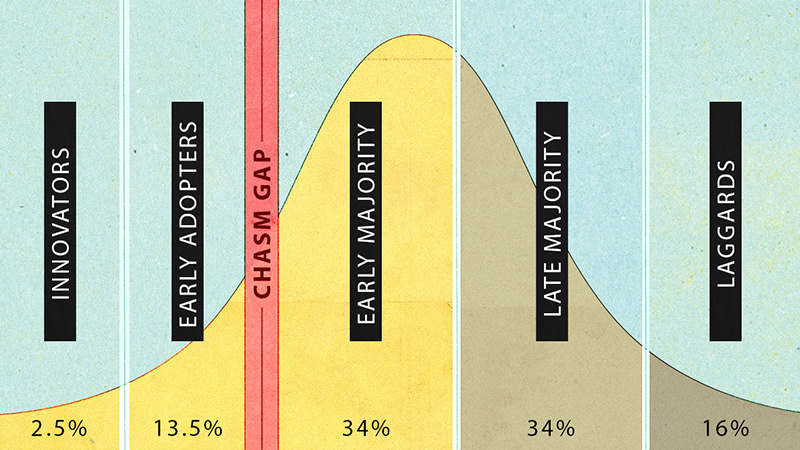

Diffusion Theory can be traced back to the 1940s, and the Chasm Gap followed in the 1990s. Its most apparent relevance today? The use of “celebrity” as a social and commercial influencer.
Adoption, Barriers and Sticking Points
The Diffusion of Innovations theory describes five distinct groups, but for a launch, we focus on the first 16%: Innovators (2.5%) and Early Adopters (13.5%). Securing this vanguard is the prerequisite for reaching the ultimate launch goal: the Early Majority (34%).
“To paraphrase David Ogilvy: you can’t bore ‘first adopters’ into buying your product, you can only interest them in buying it”.
To engage this first 16%, they need to see more than just a spec sheet. They need to recognise compatibility with their existing experiences while feeling the prestige of being first. These people are your most valuable asset; they have a disproportionate influence. They are the storytellers who facilitate the move toward the Early Majority.
Crossing the Chasm
The Early Majority is the commercial “holy grail,” but they are separated from the early adopters by the “Chasm Gap.” This group doesn't care about "newness"—they care about observable results and peer-group perception.
“The essence of brand-led thinking is storytelling.”
By focusing on a strategy that supports first adopters in re-telling your story, you create the mainstream consciousness required to leap that chasm.
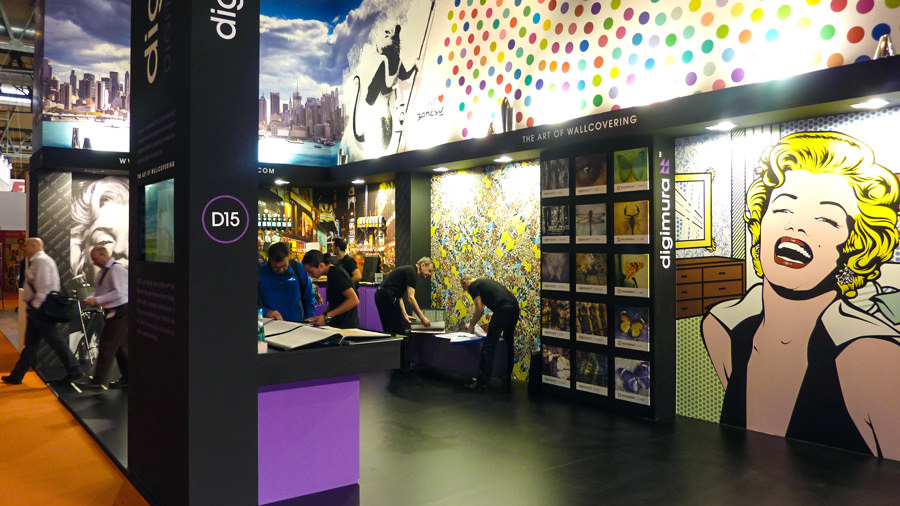

A mobile phone snap-shot of the team setting up a launch event in Spain. The result was a few hundred qualified leads for follow-up; we also learned quite a bit about how to deal with the perceived barriers to (Digimura) product adoption.
The Successful Launch of The Digimura Brand
The launch focused entirely on opportunity. We didn't just sell wallpaper; we sold the transformation of blank walls in receptions, hotels, and offices.
We focused on the quality of texture and the printed finish. We proved its compatibility with the technology PSPs already owned and offered technical training to remove the fear of the unknown. Digimura succeeded because the first adopters were interested enough to begin the story for us.
Tipping The Digimura Brand into The Mainstream
A tipping point occurred when HP lent its brand weight to the “Digital Décor” trend. It is a certainty that HP influenced the rapid adoption of the Early Majority, even using Digimura in their global demos and swatch books.
We’ll take the credit for the strategy; HP provided the validation. When a global titan adopts the same narrative you’ve been building, you know you’ve successfully shifted the market’s gravity.
A simple B2B video created for our first launch exhibition. Used to show PSPs the familiar yet new idea behind the installation of digitally-printable wallcoverings and now viewed well over 100,000 times.
Building a Valuable Brand
Today, Digimura is a self-sustaining business opportunity. It has elevated the reputation of its parent company and generated high-value revenue streams that didn't previously exist.
The takeaway: Increase the odds of success by applying brand-led thinking to your launch strategy. Focus on the first adopters, but keep the mainstream top-of-mind. If your business isn't already known for innovation, you cannot rely on your corporate name alone. “You must build an engagement story around the product itself.”
If your product is currently being sold on price and specs alone, you aren't building a brand—you’re managing a commodity.
Are you ready to start building a brand story that leaps the chasm?